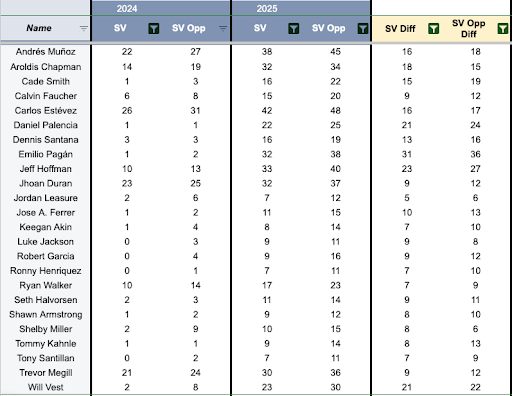
There were 24 relief pitchers who saw an increase by five or more save opportunities while converting five or more saves in 2025 compared to 2024. When we filter down to which relievers had 15 or more saves in 2025 than in 2024, the list shrinks to eight players. Relievers that met those thresholds include Andrés Muñoz, Aroldis Chapman, Cade Smith, Carlos Estévez, Daniel Palencia, Emilio Pagán, Jeff Hoffman and Will Vest. We have a mixture of relievers with closer experience seeing a higher workload and pitchers who consistently earned save chances with success in 2025.
[Join or create a Yahoo Fantasy Baseball league for the 2026 MLB season]
The visual below shows the relievers who met the previous threshold of five or more save opportunities and five or more saves in 2025 than in 2024:
On the flip side, the list of relievers who saw their save opportunities and conversions drop by five or more includes Camilo Doval, Emmanuel Clase, José Alvarado, Josh Hader, Kyle Finnegan, Mason Miller and Ryan Helsley. Alvarado was the only reliever with single-digit saves. Doval was leading the Giants in saves (15), though Ryan Walker ate into his save chances, with 10 in the first half of the season before Doval was traded to the Yankees.
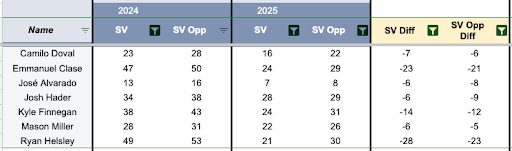
Meanwhile, Clase missed the final two months after being investigated for alleged gambling charges, so Cade Smith took on a heftier load. Similar to Doval, Helsley was traded to another team (Mets), and he didn’t convert a save in the second half out of four chances. Helsley signed with the Orioles and should slide into the primary closer for the new team (more on him below). Similarly, Finnegan was traded from the Nationals to the Tigers. Finnegan logged four saves out of five chances in the second half of the season with the Tigers.
This data reminds us that the closer market can have consistent players to target while understanding there can be volatility with trades, injuries and player struggles. We have several potential reliever targets, fades and sleepers to consider during draft season.
Proactive Picks
Ryan Helsley, Orioles (Yahoo ADP 140.5)
Ryan Helsley signed with the Orioles, filling a void with Félix Bautista undergoing shoulder surgery in August 2025. After a career season of 49 saves in 2024, the Cardinals traded Helsley to the Mets, leading to a significant role change. The 2025 ratios were awful for Helsley, though his 4.03 xERA and 15% swinging-strike suggested the skills still existed, with poor luck. Regression was expected for Helsley, though, after a 2.04 ERA, 3.52 xERA and an 18% swinging-strike rate in 2024.
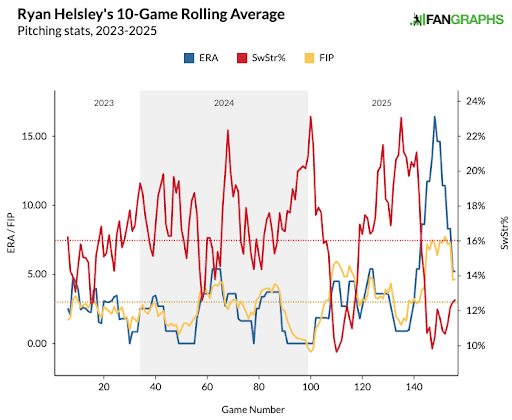
Helsley’s slider was nasty, eliciting a 23.1% swinging-strike rate, as a pitch he throws often to right-handed hitters (52.7%) and lefties (41.8%). He throws a high-velocity, gyro-like slider that makes hitters chase it outside the zone, with a career 40.3% chase rate. We want at least one dominant pitch for a closer, which Helsley possesses.
Meanwhile, Helsley’s four-seamer has been crushed against right-handed hitters (.526 wOBA, .455 xwOBA) and left-handed hitters (.471 wOBA, .375 xwOBA). That’s concerning because Helsley’s four-seam generates above-average induced vertical break while paired with above-average extension that comes from a high arm slot (62 degrees). He might be trying to pound the heater in the zone, expecting to find success, though he may benefit from lowering the zone rates. For context, Helsley threw the four-seamer in the zone 60 to 61% of the time over the past two seasons.
If Helsley makes a small tweak to the four-seam locations, we will have more confidence in his dominance. Regardless, Helsley should be the leading closer option for the Orioles after they relied on Keegan Akin (8 saves), Dietrich Enns (2 saves), and Corbin Martin (2) with Bautista sidelined.
Ryan Walker, Giants (Yahoo ADP 192.3)
Once Doval was traded, Ryan Walker had seven saves with Spencer Bivens (3) and Tristan Beck (2) being the other relievers with save conversions in the second half of the season. Walker comes at hitters from a low arm and cross-body approach, which likely involves volatility in his command. Interestingly, Walker’s swinging-strike rate fell to 9% in 2025 after being around 12-13% in the previous two seasons. That’s slightly concerning to have a reliever earning save chances with below-average stuff from a whiff standpoint.
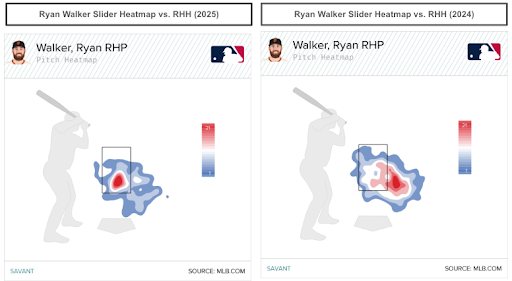
Walker’s slider typically had been filthy, inducing an 18% swinging-strike rate throughout his career. Unfortunately, Walker’s slider swinging-strike rate fell to 12.8% in 2025. The slider’s pitch movement profiles hadn’t changed much, with 14-15 inches of glove-side sweep. There’s a good chance that the slider’s whiffs and results regressed based on the pitch locations.
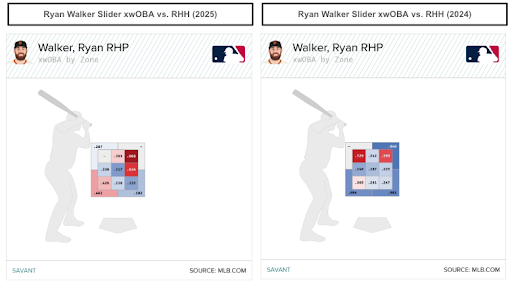
When Walker left the slider in the zone, right-handed hitters were crushing it in 2025. That’s evident by Walker’s slider allowing a .294 wOBA (.307 xwOBA) in 2025 and a .256 wOBA (.271 xwOBA) in 2024 against right-handed hitters when thrown in the zone.
Nonetheless, with Doval gone, Walker should eat up the majority of the Giants’ save chances.
The one wild card involves the Giants having a new manager in Tony Vitello, who comes from the college ranks formerly as the coach at the University of Tennessee. Will Vitello rely on Walker or make it somewhat of a closer committee in San Francisco? Walker’s draft price is somewhat discounted, making him an interesting mid-round second closer to target.
Fades
Daniel Palencia, Cubs (Yahoo ADP 171.1)
The Cubs tried to lean on veteran Ryan Pressly as their closer in 2025, but he struggled and they turned to Daniel Palencia, who was one of the waiver-wire gems at the closer position in 2025. He dealt with a shoulder strain in early September, then returned later that month. There’s a chance Palencia could take another step forward in 2026, given the above-average 13.6% swinging-strike rate. Like other relievers, Palencia struggled with control, though his ball rate improved to 34% after being around 39-40% in the previous two seasons.
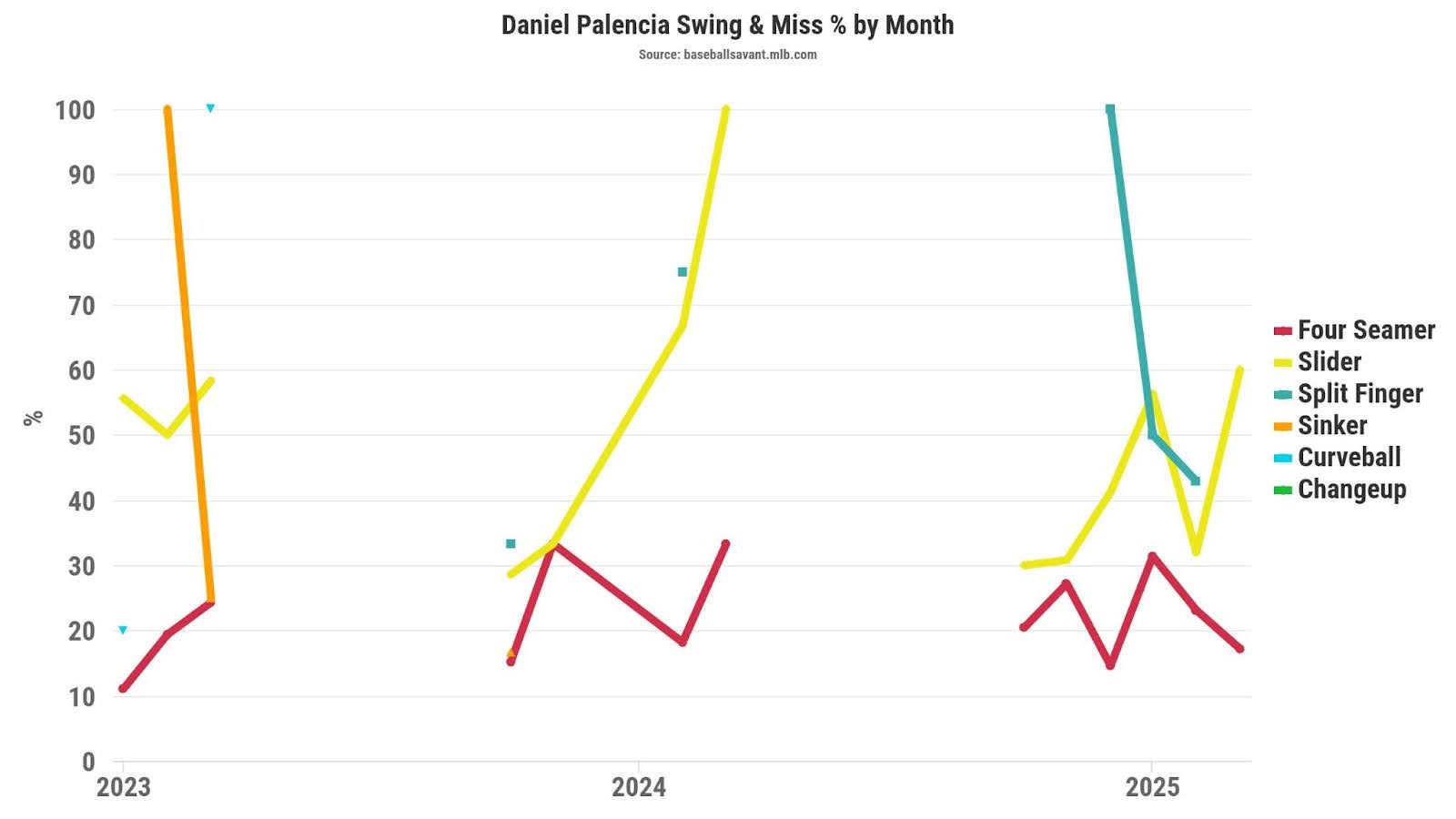
Palencia’s slider continues to headline his arsenal, with a 19.6% swinging-strike rate in 2025, compared to a career average of 21.5%. The slider added nearly three inches of downward movement in 2025, as a breaking ball that he throws low and away to right-handed hitters. Palencia’s slider generates whiffs and weak contact (.231 wOBA, .175 xwOBA) against right-handed hitters in 2025.
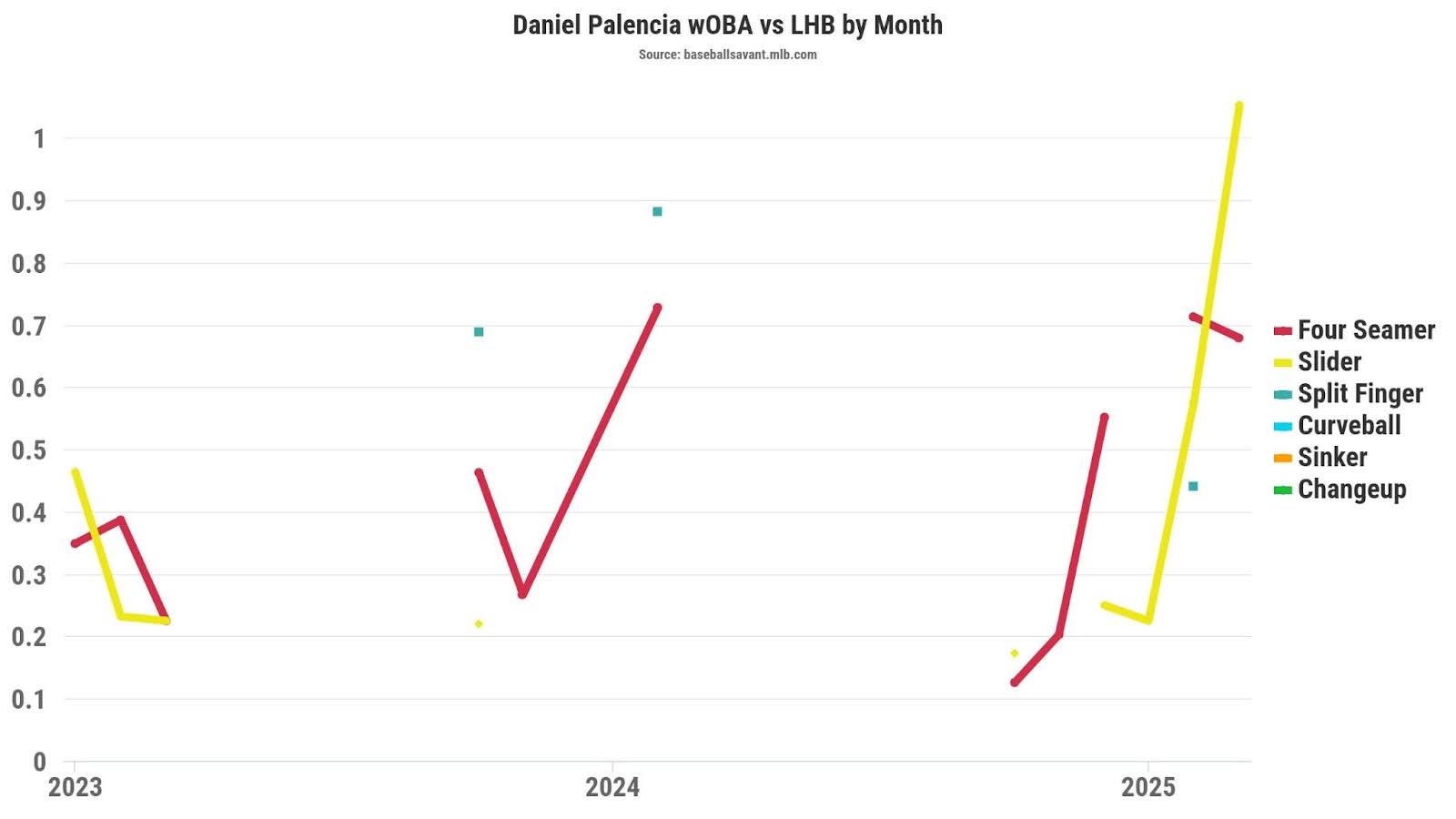
Unfortunately, left-handed hitters crushed Palencia’s slider (.383 wOBA, .313 xwOBA) and four-seamer (.352 wOBA, .366 xwOBA). That suggests Palencia needs an offering to suppress left-handed hitters or they’ll continue to do damage. He sprinkled in a splitter 38 times (8.6%) that allowed a .147 wOBA (.225 xwOBA) against lefties in 2025. It’s easier said than done, but it would benefit Palencia to work on developing a splitter to attack lefties.
That said, if Palencia struggles to find another pitch to address the issues against left-handed hitters, we could see the Cubs turn toward Phil Maton or Hunter Harvey.
Trevor Megill, Brewers (Yahoo ADP 158.1)
Trevor Megill (6) and Abner Uribe (5) shared save chances in the second half of the 2025 season. Megill dealt with an elbow strain in late August, causing him to miss over one month before returning in late September. It’s concerning when a pitcher ends the season injured; hard to have injury optimism heading into the following season. That’s especially true with Megill, who averaged over one month on the injured list in four of the past five seasons.
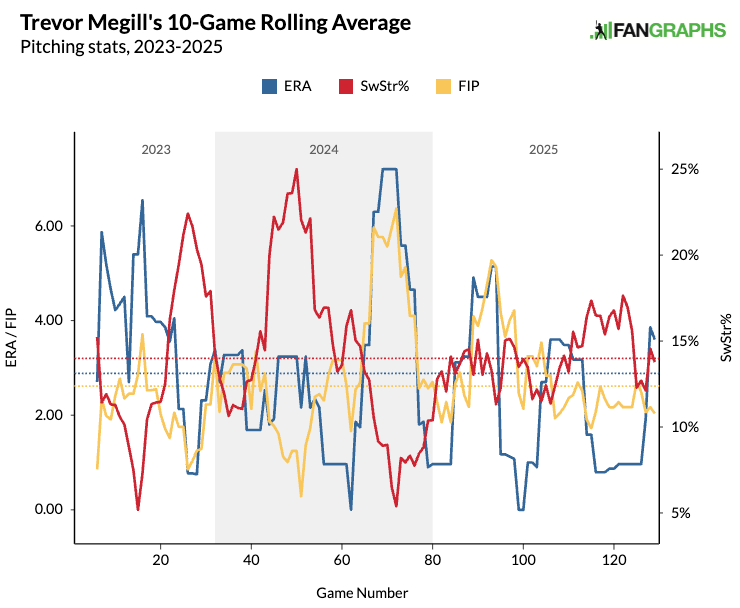
Megill has been successful, compiling 51 saves over the past two seasons. The skills support Megill’s save chances, evidenced by a 32% ball rate and a nearly 15% swinging-strike rate over the past two seasons. Megill saw the ratios improve late in the 2025 season, with a slight uptick in his swinging-strike rate. We’re not denying Megill’s skills and recent track record, but there’s a good chance Megill misses time again in 2026, opening the door for Uribe.
Uribe’s stuff finally led to save chances in 2025, though there should be some ratio regression, since he had a 2.80 xERA, over one run higher than his actual ERA (1.67). With Uribe’s sinker and slider mix, he provides that optimal groundball and strikeout approach. That’s evident in Uribe’s sinker generating a 64% groundball rate and the slider inducing a 19% swinging-strike rate.
The draft market has been torn on Megill and Uribe, but we prefer to take a chance on Uribe since he possesses the stuff to generate whiffs and weak contact, without the injury history of Megill.
Sleepers
Dennis Santana, Pirates (Yahoo ADP 181.9)
In the second half of the season, Dennis Santana had 10 of the 12 saves for the Pirates. They traded David Bednar to the Yankees, aligning with Santana earning save chances. Bednar struggled in 2024, and Aroldis Chapman stole save opportunities. Santana has been waiting for his chance, and he performed relatively well in 2025.
He might be due for regression since he outperformed his expected ERA (3.96), with an actual ERA of 2.18. Santana showed better control, with a 30% ball rate in 2025 compared to a career ball rate at 34%. Meanwhile, Santana’s swinging-strike rate was above 13% again in 2025, suggesting there’s above-average stuff, but not near-elite. However, Santana does have one near-elite pitch for whiffs via the slider, given a 20.1% swinging-strike rate.
As Santana should, he increased his slider usage to 46.4% in 2025, up from 32.3% in 2024. Santana made a 10 percentage point increase in usage to right-handed hitters (49.3%) with a 20-point jump to lefties (42.5%). Interestingly, Santana’s slider doesn’t have an above-average movement profile, yet it generates weak contact against righties (.207 wOBA, .222 xwOBA) and lefties (.225 wOBA, .270 xwOBA).
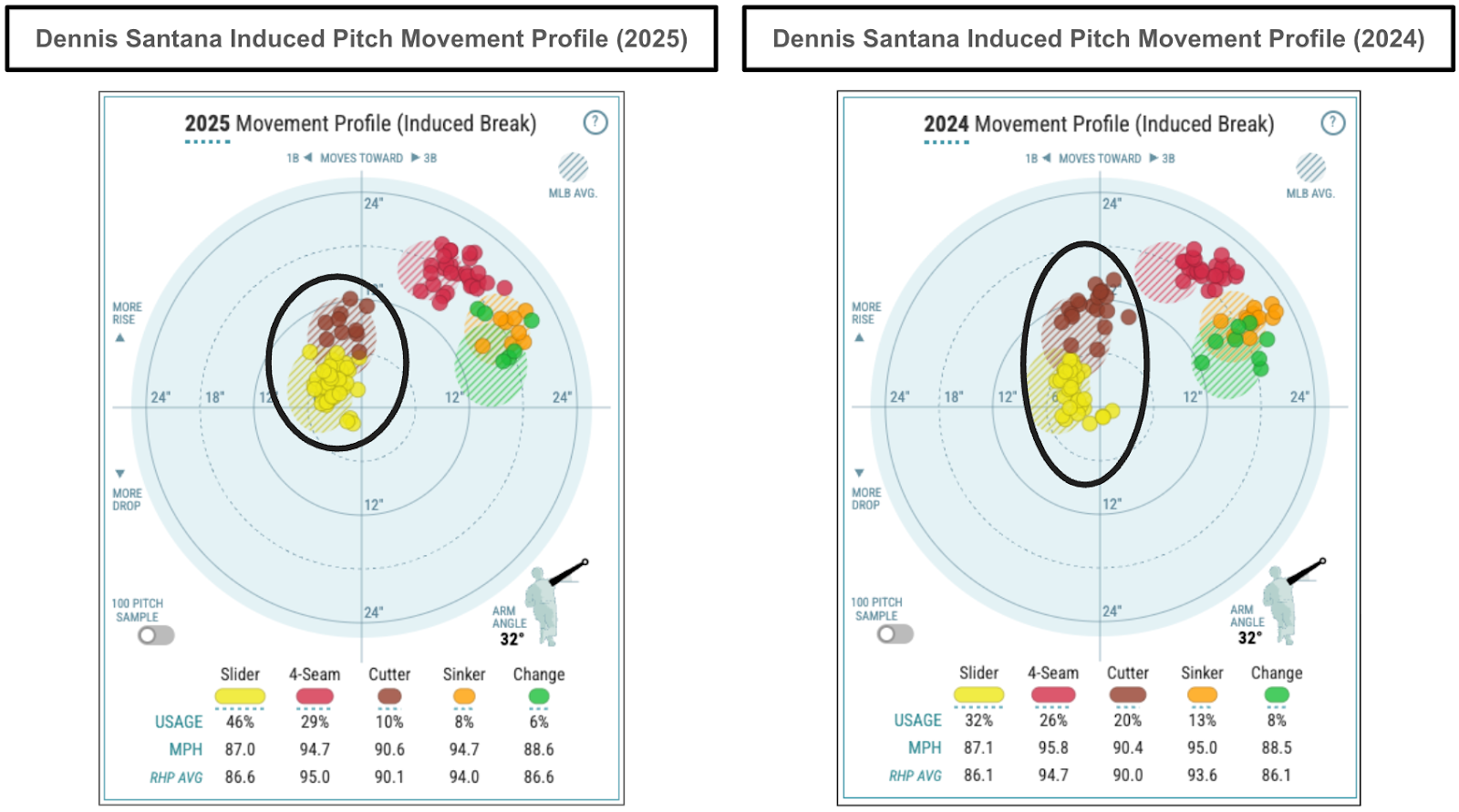
That could suggest Santana commands his slider well since it doesn’t have a filthy movement profile. Or Santana’s slider keeps hitters guessing with another pitch having a similar profile, which can be seen via the induced movement profiles above. It’s probably a mixture of both factors, with the cutter being a harder-thrown version of the slider. Santana’s cutter elicits weak contact (.265 wOBA, .322 xwOBA) to right-handed hitters. However, Santana’s cutters tend to be less effective against lefties (.313 wOBA, .317 xwOBA) in 2025.
Besides Bednar, Santana had the highest game leverage index on the Pirates, showing the team trusts him in high-leverage situations. Santana fits nicely as an RP2 for around 25 saves at a cheaper draft cost.
Pete Fairbanks, Marlins (Yahoo ADP 163.7)
Pete Fairbanks logged 20 or more saves for three consecutive seasons, though he earned 77% of the team’s saves in 2025, which was unusual. For context, Fairbanks had 45% of the team’s saves in 2024 and 60% of the team’s saves in 2023. It’s worth noting that Fairbanks has dealt with his fair share of injuries in 2023 and 2024, causing him to miss over one month in both seasons. Meanwhile, Fairbanks was healthy in 2025.
He signed with the Marlins in December on a one-year deal worth $13 million, so it’s a low-risk investment for the Marlins that they could move at the trade deadline. When healthy, Fairbanks typically performed well with the strikeout skills to support the outcomes. Fairbanks had a 12.8% swinging-strike rate in 2025, with a career low in 2024 (9.5%). However, Fairbanks boasted a swinging-strike rate north of 13% throughout his career.
Interestingly, Fairbanks’s slider took a slight step back from a whiff standpoint, with a 13% swinging-strike rate in 2025 and 10.3% in 2024. That aligns with the overall dip in swinging-strike rate during the past two seasons. The slider’s movement profile suggests more whiffs on breaking pitch that generates 6.5 inches more downward movement than the average slider. Typically, we find pitches that possess more vertical movement tend to elicit more whiffs.
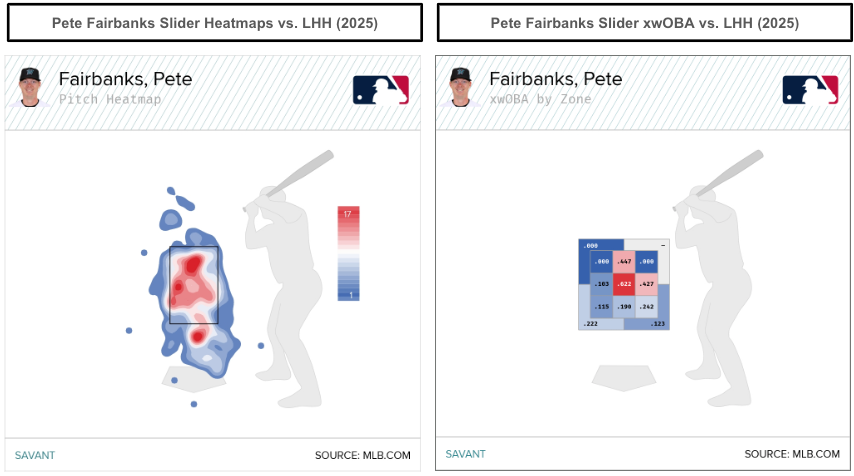
My guess would be slider locations might be an issue, though a reliever’s pitches can be volatile in smaller samples. Based on the slider heatmaps, it looks like he might be throwing it too often in the heart of the zone, which leads opposing hitters to wait on the slider. We’ve heard rumors that the Rays’ pitchers have been instructed to throw their best pitches in the heart of the zone, to see whether opposing hitters can hit them. Fairbanks may want to focus on a location adjustment for the slider if the high-end downward movement isn’t generating the expected whiffs.
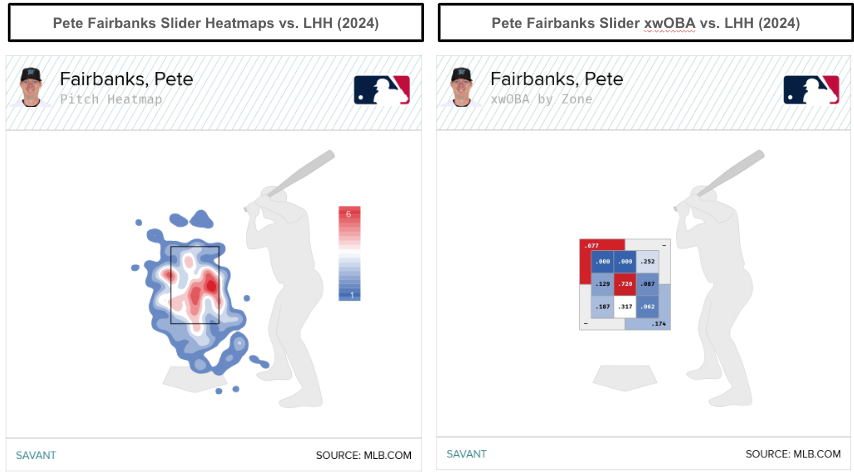
The other concern involves Fairbanks having potential left-handed hitter problems. Left-handed hitters have been doing damage and making loud contact against the four-seamer over the past two seasons, with the slider being decent, but not dominant. That’s especially true since left-handed hitters have been crushing the heater, evidenced by a .341 wOBA (.376 xwOBA) in 2025 and a .379 wOBA (.369 xwOBA) in 2024. Fairbanks may want to develop the changeup that he hardly uses, with a career 18% swinging-strike rate. Furthermore, Fairbanks’s changeup allowed a .204 wOBA (.232 xwOBA) against left-handed hitters in a small sample of 40 pitches in 2025.
The Marlins have been rotating relievers as their primary closer. A.J. Puk (15), Tanner Scott (12) and Dylan Floro (7) led the Marlins in saves in 2023. Scott (18) and Calvin Faucher (6) were the only two Marlins’ relievers with five or more saves in 2024. Then Faucher (15) led the team in saves with Ronny Henriquez (7) sneaking into the mix in 2025. Faucher still remains on the Marlins, but Fairbanks showed he can handle the majority of the team's save opportunities with the Rays across multiple seasons.
Griffin Jax/Edwin Uceta, Rays (Yahoo ADPs: 204, 203.3)
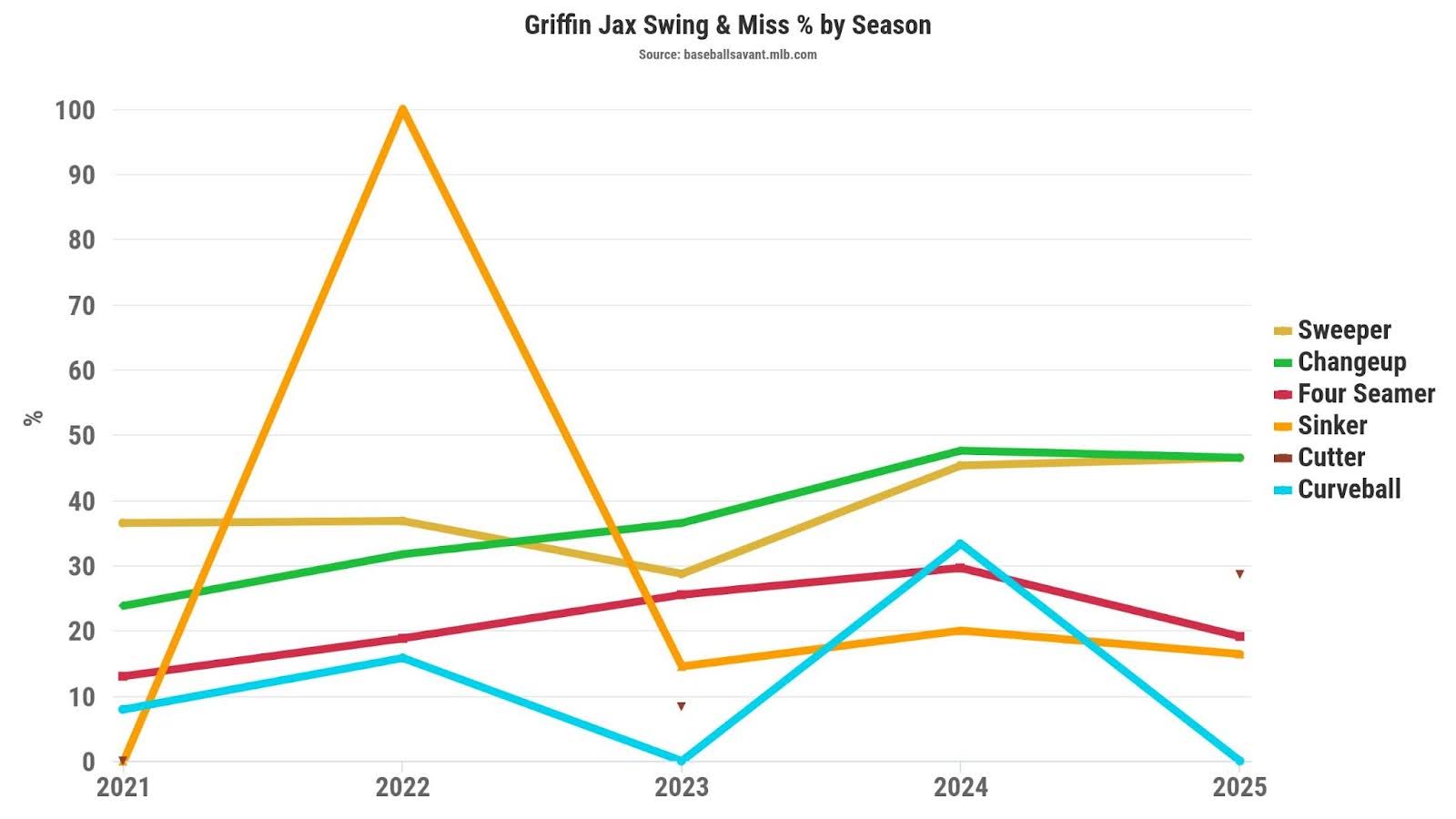
The Rays value stuff, as they rank second in Stuff+ behind the Phillies. Griffin Jax possesses near-elite stuff, evidenced by two primary pitches eliciting a swinging-strike rate above 21% via the slider (21.1%) and changeup (27%). Jax’s sweeper is nasty against right-handed hitters, allowing a .149 wOBA (.168 xwOBA). On the flip side, Jax’s changeup serves as a deadly option to lefties, with a .146 wOBA (.150 xwOBA).
Edwin Uceta could be in the mix for saves with Jax, making this a muddy reliever room to figure out. Uceta’s arsenal doesn’t grade well in Stuff models, likely because he throws from a lower arm angle (14 degrees), giving him a Luis Castillo-type arm slot. He throws two pitches with an above-average swinging-strike rate, including the four-seam (17.6%) and changeup (19.1%).
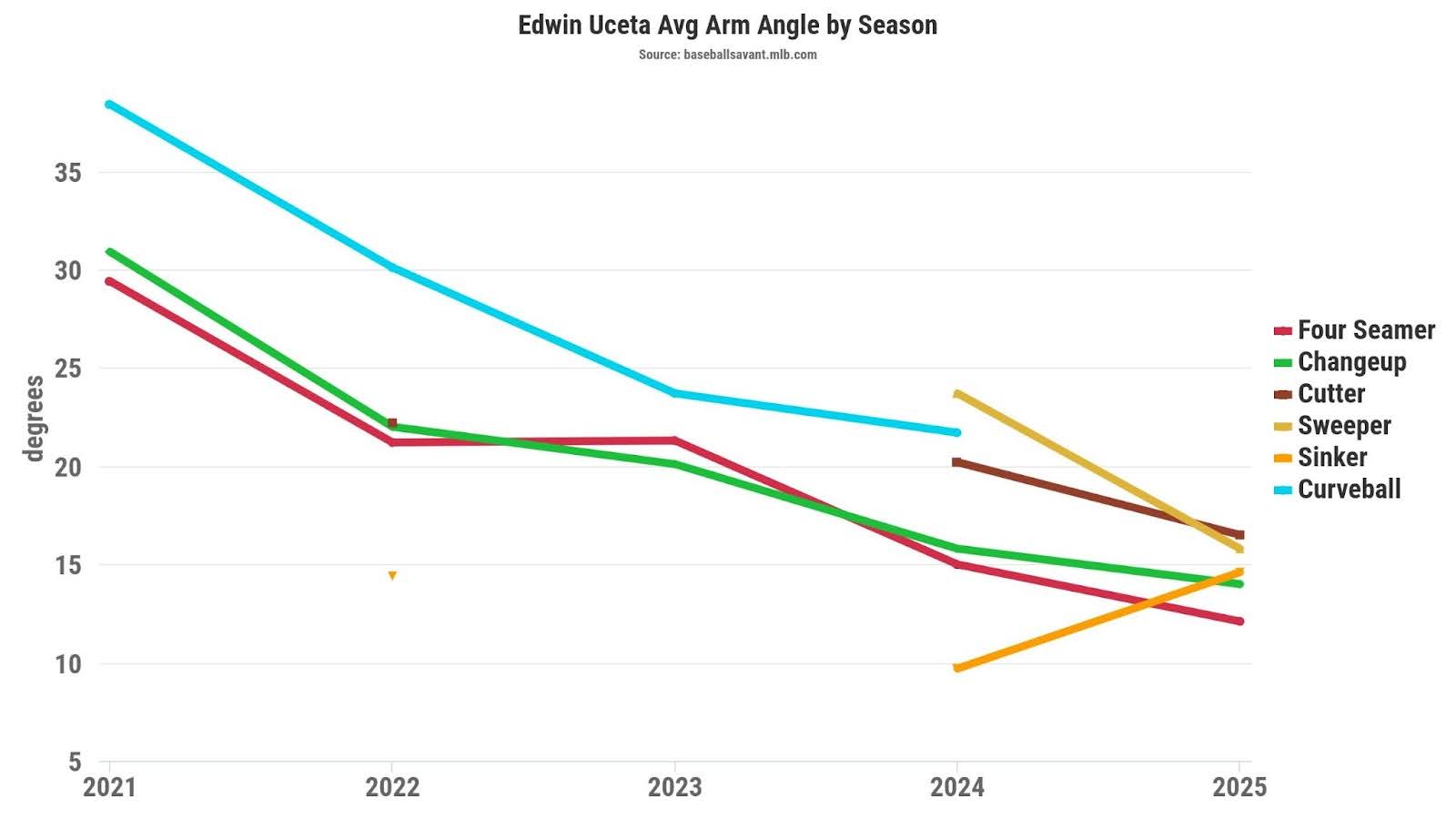
With the lower armslot, Uceta’s changeup and four-seam seem to have reverse splits, where the changeup performs better against right-handed hitters (.191 wOBA, .258 xwOBA) and four-seam is better against lefties (.221 wOBA, .227 xwOBA).
Uceta’s draft price has been slightly lower than Jax's. We’ll want to take shots at the Rays’ closer options, but don’t over-invest in either one.
Top-12 RP rankings
Mason Miller, Padres
Edwin Díaz, Dodgers
Cade Smith, Guardians
Andrés Muñoz, Mariners
Jhoan Duran, Phillies
Devin Williams, Mets
David Bednar, Yankees
Aroldis Chapman, Red Sox
Jeff Hoffman, Blue Jays
Ryan Helsley, Orioles
Raisel Iglesias, Braves
Ryan Walker, Giants